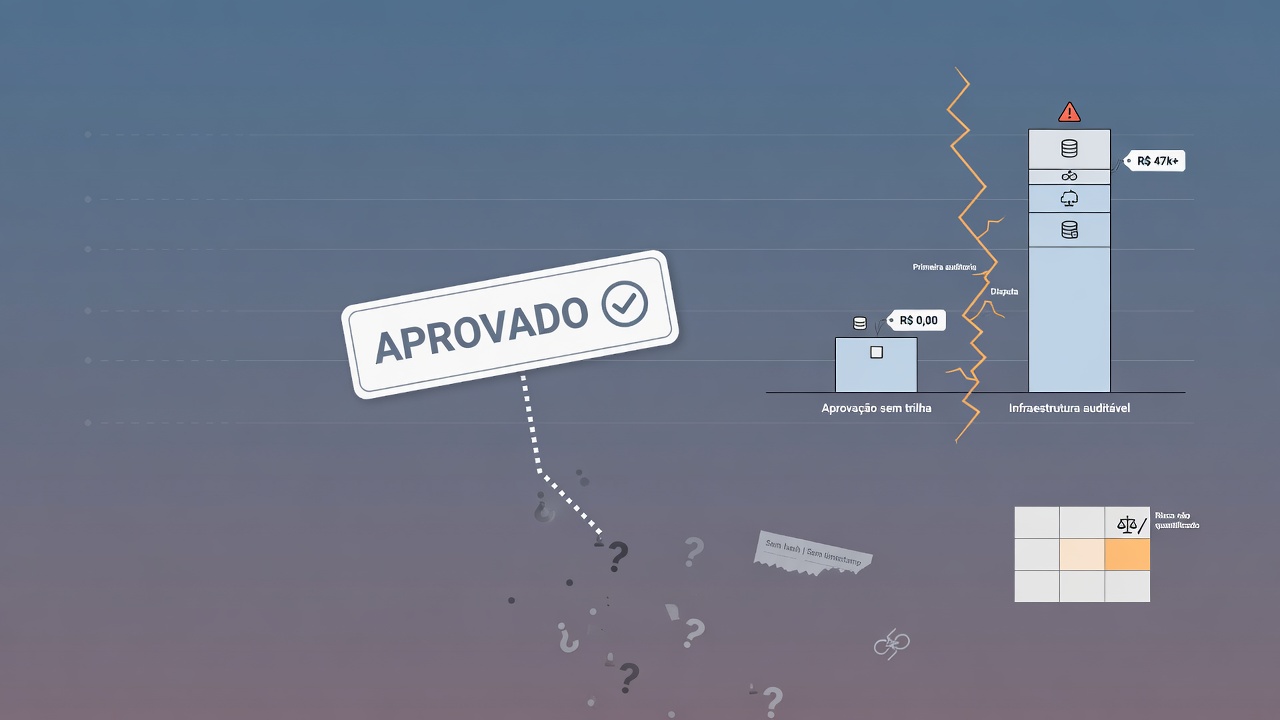
No one is usually evaluated for "having a good audit trail" in day-to-day work. The informal process works most of the time — and that is why investment in approval governance competes with other priorities. The real cost, however, concentrates on rare events: audits, customer disputes, labor inquiries, or enterprise account vendor questionnaires.
This article provides a framework for discussing this cost in committee, with illustrative scenarios (values and probabilities are orders of magnitude for debate, not guaranteed forecasts).
The question that operational ROI does not answer
The classic calculation multiplies "minutes saved per approval" by the approver's cost. The result is usually modest — and ties with the price of a tool.
This calculation measures the happy path. The damage from poorly documented approval appears when something goes wrong or when a third party demands proof. The more useful question is:
How much does a poorly auditable approval incident cost, multiplied by the chance of it occurring in the year?
Scenario 1 — Audit with a defined deadline
Situation: a mid-sized company prepares for SOC 2 Type II; the auditor requests, from the last 90 days, who approved each elevated access in production, with timestamp and justification.
| Approach | Typical effort |
|---|---|
| No tool (PRs, Slack, email) | Days to weeks of archaeology by a senior engineer or head of ops |
| With workflow trail + consolidated export | Query and export in minutes to hours |
Illustrative estimate: 80 hours × high internal hourly cost can represent tens of thousands in local currency — before any roadmap delay. This effort repeats with every audit cycle or vendor questionnaire.
With Apruvly, each decision is linked to a workflow_id queryable via GET /api/v1/workflow/:id. On the Business ($149/month) and Professional ($349/month) plans, asynchronous export at /security/audit-export generates a ZIP (CSV or JSON) with workflow decisions and account events, in intervals of up to 31 days.
Scenario 2 — Client disputes an old decision
Situation: a B2B client claims that a charge or debit was not authorized. The company believes authorization occurred, but the evidence is in an informal message (WhatsApp, lost email, employee who left).
| Approach | Common outcome |
|---|---|
| No structured record | Weeks of investigation; eventual refund or settlement to close the conflict |
| With documented workflow | Response with approver, timestamp, IP, comment, and context of the approved object |
Illustrative estimate: direct loss + time from legal and leadership can easily exceed the annual cost of a Business plan — a single poorly resolved incident.
Scenario 3 — Internal or labor inquiry
Situation: a former employee claims they were pressured to perform an irregular operation; the company needs to demonstrate that the process was followed and approved by the correct instances.
In judicial or settlement contexts, who has consistent contemporaneous records negotiates better. Slack screenshots and testimonies are more fragile than workflow history with approver, date, channel, and comment.
Expected risk mathematics (illustrative example)
| Variable | Example value |
|---|---|
| Annual probability of at least one relevant incident | 50–70% (higher in B2B enterprise) |
| Average cost when it occurs | equivalent to tens of thousands in local currency |
| Annual expected risk | probability × average cost |
Compare with infrastructure cost:
| Apruvly Plan | Price (USD/month) | Credits/cycle | Audit export |
|---|---|---|---|
| Free | $0 | 180 | — |
| Starter | $19 | 10 000 | — |
| Growth | $59 | 40 000 | basic logs (IP) |
| Business | $149 | 150 000 | consolidated export |
| Professional | $349 | 400 000 | consolidated export |
Billed via Stripe, in USD. The Free plan allows validating a critical flow (1 step, 2 simultaneous workflows); formal export and long retention are on higher plans.
Operational ROI — less reconfirmation, automatic escalation, less status chasing — enters as an additional benefit, not the sole justification.
Costs hard to put on the spreadsheet
Three effects appear after the company structures approvals:
- Enterprise sales cycle: answering "yes, native trail, I can demonstrate now" shortens due diligence; hesitating with "we use Slack" freezes the deal.
- Ops onboarding: new operators learn "who approves what" in one interface, not three weeks of oral tradition.
- Governance before the board and investors: traceable critical decisions reduce time spent on defensive discussions.
What Apruvly delivers in this context
- Multi-step and multi-channel workflows via API or designer.
- Decisions with challenge UUID, timestamp, approver, comment; IP and user-agent according to the plan's audit level.
- Automatic escalation by timeout.
- Data retention from 7 days (Free) to 90 days (Professional).
- Consolidated audit export on Business and Professional plans.
Start with no commitment
The Free plan offers 180 credits/month, no card required. Set up a real flow from your domain (not just a generic example) and evaluate whether the trail meets the questions your compliance or clients are already asking.
Account at apruvly.io.