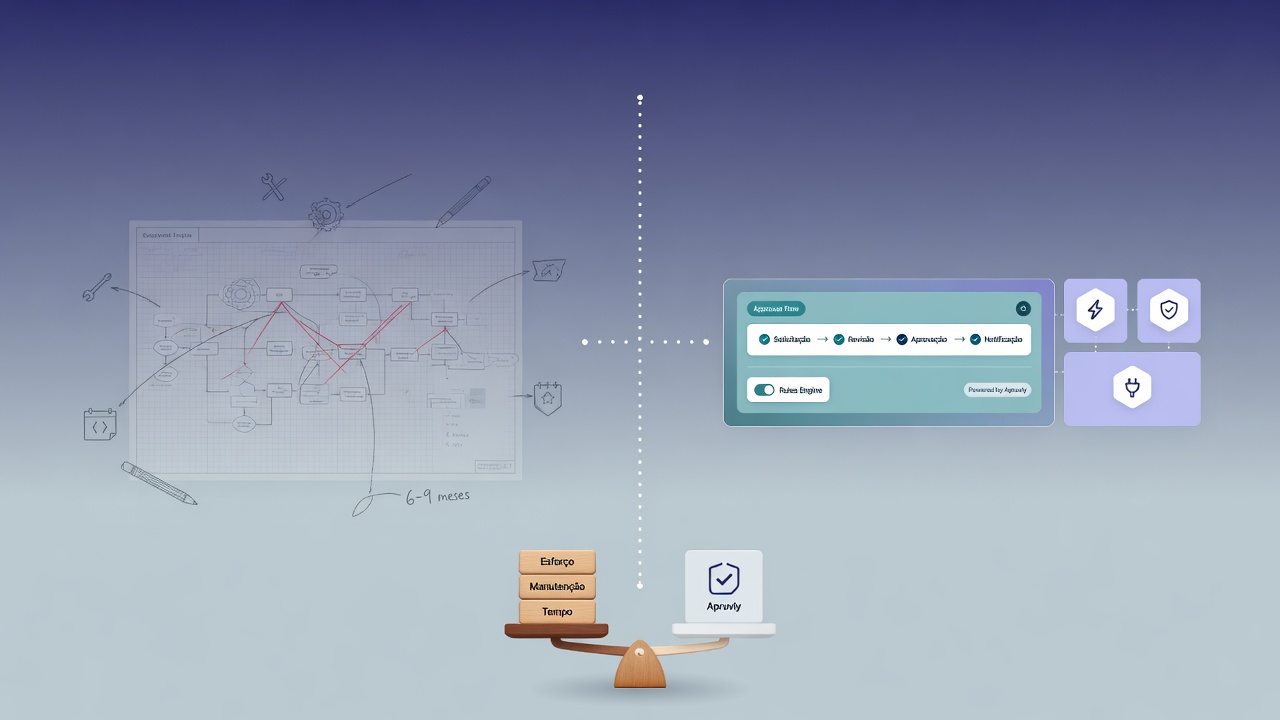
The question "can't we build this internally?" comes up in every conversation with tech leads. The honest answer: it depends on what approval means for your business — core product, regulatory isolation requirement, or just another feature on the roadmap.
When building makes sense
1. Approval is the product. Governance or compliance platforms whose differentiation is the approval flow itself need to control the engine in depth. External infrastructure complements but does not replace the core.
2. A single trivial and stable flow. E.g., "every PR needs a review on GitHub". This fits in dozens of lines; it does not justify external integration.
3. Data cannot leave the perimeter. Sectors with strict egress restrictions may require on-premises deployment. Apruvly offers an enterprise option along these lines (see docs/onprem-shield.md), but building internally remains valid when the policy is "zero cloud vendor dependency".
4. Team and long-term roadmap for an internal product. Building does not end at the MVP: maintenance of integrations, concurrency edge cases, and internal support last for years.
If two or more of these points apply strongly, building may be the correct decision.
When building becomes a scope trap
Frequent symptoms:
- Approval is a feature of the product, not the entire product.
- The roadmap already has dozens of items that differentiate you in the market.
- Engineering estimates "two to three weeks" for the complete engine.
In practice, v1 usually underestimates:
| Component | Optimistic estimate | Realistic effort (order of magnitude) |
|---|---|---|
| CRUD + states | days | ~1 week |
| Email with templates | days | ~1 week |
| Slack (OAuth + bot + interaction) | days | ~2 weeks |
| Escalation by timeout | days | ~1 week |
| Webhooks with retry and SSRF | days | ~1 week |
| Multi-account + permissions | days | ~2 weeks |
| Idempotency / race / double-click | day | ~1–2 weeks |
| UI or designer | week | weeks to months |
| WhatsApp / Teams / SMS / … | "later" | weeks per channel |
Realistic total for a usable v1: months, not weeks — before ongoing maintenance.
Where Apruvly competes well
1. Time to first real approval
A single POST /api/v1/workflow/ call with a valid JSON config puts notifications, decision links, and audit trail into production the same day — versus weeks of in-house scaffolding.
2. Multi-channel without N parallel integrations
Supported channels as steps: email, slack, ms-teams, whatsapp, twilio-whatsapp, twilio-sms, telegram, discord, dingtalk. Each one requires its own OAuth, templates, rate limits, and retries if built from scratch.
Plan gates (summary):
- Twilio (SMS/WhatsApp): Starter+
- Integrator webhook on API key: Starter+
- MCP for agents: Growth+ ($59/month)
- Custom SMTP: Business+ ($149/month)
- Consolidated audit export: Business+
3. Compliance trail
Each workflow has an ID; each approver receives a challenge UUID; decisions record timestamp, approver, comment, and, depending on the plan, IP and user-agent. Asynchronous ZIP export on Business and Professional (/security/audit-export).
4. Concurrency and idempotency
Transitions persisted in Postgres with SELECT FOR UPDATE; second click on the same challenge is rejected; replay of an old link does not duplicate the decision.
5. Predictable cost
Credit model: 1 per notified recipient (details in docs/pricing.md). No surprise "broadcast to 10 thousand recipients" if you model UnitCost before creating the workflow.
Where building in-house still wins
- Rules with deep lookup in your database at decision time, without passing context via API.
- Extreme latency within the same process (rare in human approval).
- Zero-egress policy with no flexibility for managed on-prem.
- Existing and stable engine — migrating for fashion rarely pays off.
Vendor dependency
Apruvly exposes a stable REST API; status and decisions are queryable and exportable; return webhooks are standard HTTP. Switching vendors requires work — as with Stripe, SendGrid, or any infrastructure SaaS. The in-house alternative trades vendor dependency for dependency on the team that maintains the code.
Decision exercise (30 minutes)
- List the five approval flows needed in the next 12 months.
- For each: channels, escalation, auditable trail, external approver without login.
- Estimate engineering effort to deliver and maintain.
- Compare with Growth ($59/month, 40k credits, MCP) or Business ($149/month, audit export, custom SMTP).
- Add the cost of delaying features that differentiate your product in the market.
If the math favors building, build. If not, ready-made infrastructure frees the team for what only your product does.
Test before deciding
Free plan: 180 credits/month, no card required. Run a real workflow from your domain and compare with the scope you estimated internally.
apruvly.io