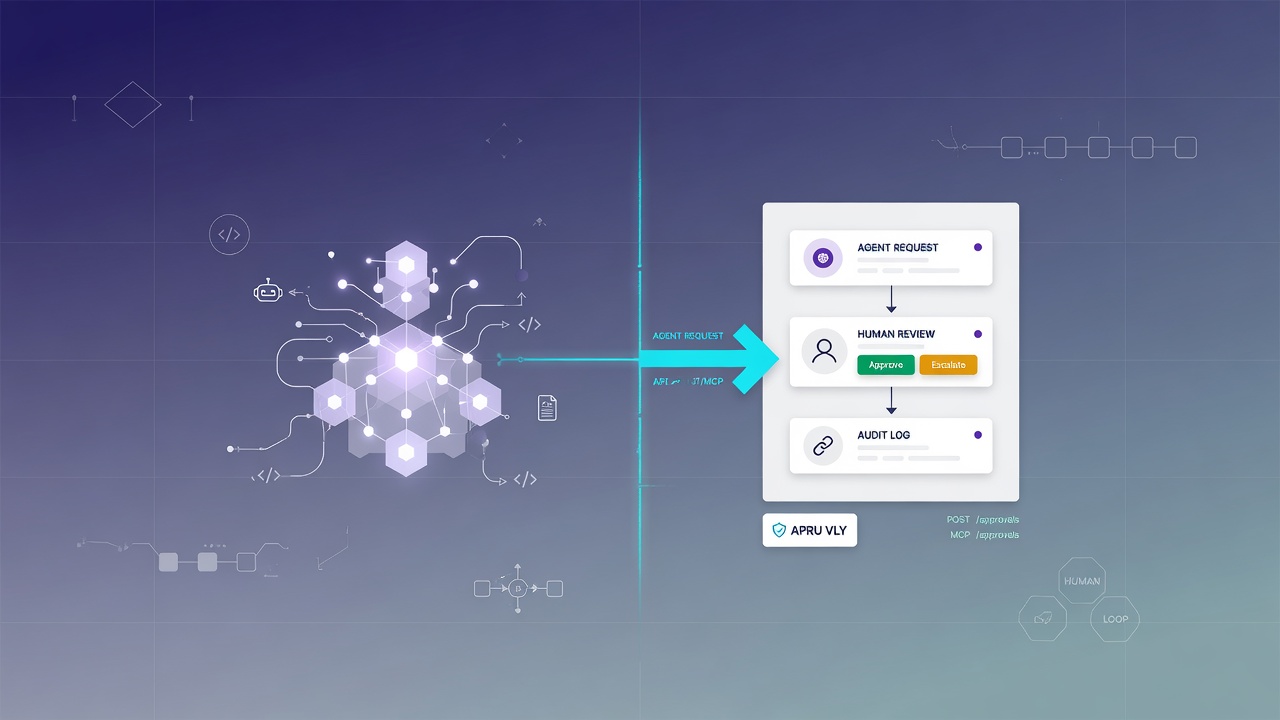
Agents that classify tickets, suggest discounts, process refunds, or update records are already in production at many companies. These are probabilistic systems: a small error rate, multiplied by high volume, produces real silent failures.
The operational question is not “is the agent useful?” — it is who authorizes the action when the impact is irreversible or above a threshold? This authorization must be fast, contextual, auditable, and scalable. Human approval has moved from sporadic forms to become the interface between agent and organization.
What agents do today (typical examples)
Recurring cases in production:
- Email refund triage with auto-approval below a set amount.
- Identification of stalled CRM opportunities with discount suggestions.
- Automatic replies to simple tickets; escalation of complex ones.
- Pre-review of contract clauses before sending to the client.
- Classification of fiscal documents and triggering of accounting workflows.
In all of them, a fraction of actions should stop before execution — due to value, ambiguity, sensitive customer, or internal policy.
Why “full auto + review later” does not scale
1. Reactive auditing arrives too late. Discovering improper refunds three months later does not undo the damage or demonstrate systemic governance to clients or regulators.
2. Passive log supervision does not work. Humans do not review an agent’s full transcript with consistent attention; effective oversight requires a targeted request at the moment of decision.
3. Regulation and contracts require human review in relevant automated decisions (AI Act, LGPD art. 20, enterprise contract clauses). “The agent decided alone” is an increasingly difficult position to defend in critical contexts.
The emerging standard:
Reversible or low-impact actions: agent proceeds. Irreversible or above-threshold actions: human approval request with context, deadline, and audit trail.
How this is implemented
Consolidated flow:
- Agent processes until a criterion (value, confidence, operation type).
- Instead of executing, it calls the approval API with title, description, and step configuration.
- Human receives notification in the preferred channel (Slack, email, WhatsApp, …).
- Human approves or rejects (optional comment).
- Agent receives the result via webhook or polling and continues or aborts.
Each decision is linked to the workflow_id: what was proposed, who decided, when, and through which channel.
The usual bottleneck is latency and volume of the approval layer — dozens of poorly formatted requests per hour without escalation stall the agent. That is why approval becomes infrastructure, not an ad-hoc webhook.
Apruvly in the agent stack
Apruvly offers the same REST API for flows triggered by people or by software, with:
- Multi-channel delivery and automatic escalation.
- Challenge UUID per approver (idempotency when the agent resends).
- Integrator webhook on the API key (Starter+) or
on.workflow_*actions. - Status query:
GET /api/v1/workflow/:id.
For agents compatible with MCP (Model Context Protocol), the Growth plan ($59/month) and above enable:
| MCP Tool | Function |
|---|---|
create_approval_request |
Creates workflow from config |
get_approval_status |
Queries status and decisions |
cancel_approval_request |
Cancels pending workflow |
API key scopes: mcp:workflow:read, mcp:workflow:write, mcp:workflow:cancel.
MCP flow example:
- Agent calls
create_approval_requestwithobject.titledescribing the proposed action and steps for the manager. - Manager receives notification and decides.
- Agent uses
get_approval_statusor receives POST onnotify_url/callback_urlwithevent: workflow_approved. - Agent executes or abandons the action in the source system.
The audit trail is identical to a refund submitted by a human employee — useful for compliance and for debugging agent behavior.
What is not yet a product (avoid confusion)
- Cross-agent approval (agent A asks agent B to approve up to limit X): not available today; would require custom design in your own layer.
- Third-party human approval marketplace with commercial SLA: possible future industry trend, not an Apruvly offering.
Trends (speculative, 12–24 months)
Human-in-the-loop request volume is expected to rise as more agents reach production. Approval UX may branch by domain (deploy vs discount vs refund), but the delivery, escalation, and auditing layer remains common. Teams that invest early in this layer avoid re-implementing under pressure after the first incident.
Where to start
A useful exercise even without an agent in production:
- List three operations you would partially delegate to an agent in the next six months.
- For each, mark the point of no return where a human must review before execution.
- Define channel, minimum context, timeout, and escalation for each point.
This becomes the specification for the approval layer — implementable via REST API or MCP.
Next step
- Free (180 credits/month): validate single-step flow and REST integration.
- Growth+: MCP and multi-level for high-volume agents.
Account at apruvly.io. API documentation at /documentation after login or on the equivalent public page.